WillowCrest Pest ManagementWillowCrest Pest Management

Subterranean Termite Treatment Charleston

Subterranean termite treatment in Charleston addresses two aggressive wood-destroying species: the native eastern subterranean termite and the Formosan subterranean termite. Formosan colonies routinely exceed several…
Get My Free Estimate →(843) 268-6994
Subterranean Termite Treatment in Charleston, SC
Quick answer
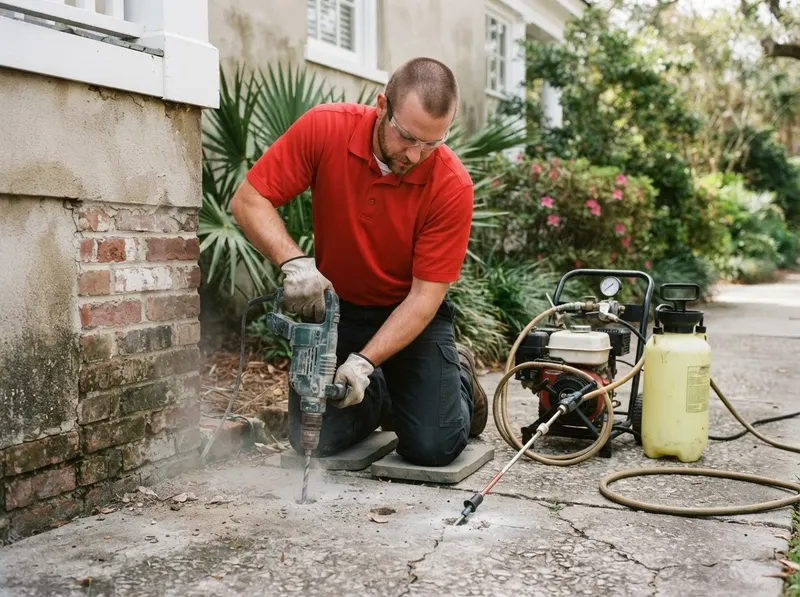
  • Scope includes a complete crawlspace and perimeter foundation trenching, rod injection, or station bait installation across building perimeters.
  • Initial diagnostic inspections occur within 24 to 48 business hours; complete liquid barrier or bait station treatments typically finish in 4 to 8 hours.
  • Comprehensive subterranean termite treatment starts at a $300 minimum charge for localized interventions, with complete whole-structure defense packages scaling from $1,200 to $2,800 depending on linear foundation footage and crawlspace dimensions.
  • WillowCrest Pest Management manages all soil trenching, non-repellent liquid injection, monitoring station arrays, and clean post-treatment backfilling.
  • Direct phone scheduling at (843) 268-6994 reserves an on-site technician who assesses wood moisture, identifies termite tubes, and validates linear foundation requirements.

Subterranean termite treatment in Charleston addresses two aggressive wood-destroying species: the native eastern subterranean termite and the Formosan subterranean termite. Formosan colonies routinely exceed several million individuals, consuming structural framing timber substantially faster than native variants. Structural integrity requires stopping foraging workers before they breach foundational sills. Property foundations across Charleston County feature diverse construction types, from raised brick piers in historic downtown districts to modern monolithic concrete slabs in coastal subdivisions. Liquid non-repellent termiticides, such as fipronil regulated by the EPA Pesticide Programs, create an invisible barrier within the ground. Foraging termites track through the treated soil without detection, inadvertently sharing the active compound across the colony matrix via social grooming and trophallaxis, which results in colony elimination within 60 to 90 days.

Foundation construction dictates the technical approach. In historic areas like South of Broad, Harleston Village, and Radcliffeborough, structures built between 1790 and 1910 rest on soft historic mortar and brick piers above unencapsulated crawlspaces. Treating these footprints requires specialized trenching around internal support piers alongside calibrated low-pressure rod injections to safeguard delicate masonry from hydraulic pressure spikes. For historic framing preservation guidelines, property owners often consult the National Park Service Preservation Briefs. In riverfront and slab-on-grade neighborhoods such as Daniel Island, Cainhoy Peninsula, and West Ashley, treatments require continuous exterior perimeter trenching, expansion-joint drilling, and monitored bait installations conforming to standards from the National Pest Management Association. The primary trade-off between systems involves immediate perimeter exclusion versus ongoing monitoring: non-repellent liquid barriers deliver immediate structural isolation lasting up to a decade, whereas baiting networks require routine annual monitoring cycles but eliminate broader subterranean foraging populations across expansive yard boundaries without intrusive slab drilling.

Local environmental variables heavily influence subterranean termite activity in the coastal Lowcountry. High relative humidity, persistent tidal flow, and shallow water tables near The Battery and White Point Garden saturate soil layers, accelerating wood decay and creating ideal nesting parameters. Wood-to-soil contacts near Charles Towne Landing State Historic Site or properties nestled under maritime live oaks near Hampton Park require immediate ground clearance; structural lumber should maintain an 18-inch clearance above raw soil to block easy termite shelter tube construction. Homeowners assessing foundation stability and moisture limits can evaluate standards published by the U.S. Department of Housing and Urban Development and the Clemson University Cooperative Extension Service. When coastal flood surges from Charleston Harbor or the Ashley River submerge barrier zones, technicians verify soil displacement to ensure the protective termiticide bond remains intact.

How much does Subterranean Termite Treatment cost in Charleston?

Targeted Pier & Foundation Spot Treatment$300 - $650
Standard Slab Perimeter Liquid Barrier (Up to 200 linear ft)$1,200 - $1,800
Raised Historic Crawlspace Treatment (Downtown Core)$1,600 - $2,800
Perimeter Bait Station Installation & 1-Year Monitoring$950 - $1,500
Pre-Purchase Wood-Destroying Insect Report (CL-100)$300 - $400

Every job gets a firm, written price after a free on-site visit.

Common questions

How does a homeowner identify subterranean termite activity in Charleston?
Subterranean termites build distinctive vertical mud tubes along masonry foundations, foundation piers, and crawlspace framing to protect their soft bodies from desiccation. Property owners across James Island and Wagener Terrace frequently spot these quarter-inch-wide dirt tunnels, discarded reproductive swarmer wings along interior window sills following warm April rains, or soft, blistered baseboard wood that reveals hollowed gallery patterns packed with sandy mud.
What regulatory standards govern termite treatments in Charleston County?
All commercial applications in Charleston County must strictly comply with regulations enforced by the Clemson University Department of Pesticide Regulation, which establishes termiticide application volume requirements of 4 gallons per 10 linear feet per foot of depth in soil trenches. Environmental restrictions set by the South Carolina Department of Health and Environmental Control additionally dictate setback guidelines to safeguard local coastal estuaries and marshland water tables.
Are subterranean termite treatments safe around pets and garden landscaping?
Modern non-repellent termiticides bind tightly to soil organic matter once applied within foundation trenches, preventing leaching into non-target garden beds or domestic water sources. Treated soil trenches are backfilled with clean soil immediately during application, which prevents companion animals from making direct contact with the product, aligning with safe application guidelines documented by the Centers for Disease Control and Prevention and the United States Department of Agriculture.
How do historic Charleston homes differ during subterranean termite mitigation?
Historic structures in Harleston Village and South of Broad often feature historic heart pine framing set over porous lime mortar, demanding careful soil injection rather than aggressive high-pressure drilling that could shatter brittle nineteenth-century brickwork. Technicians balance treatment volumes to prevent moisture saturation in tight foundation crawls while referencing historical structural safety practices outlined by the Historic Charleston Foundation.
What happens after scheduling an on-site evaluation with WillowCrest Pest Management?
A technician arrives to execute a non-invasive visual inspection, mapping mud shelter tubes, checking wood moisture metrics, and measuring the foundation perimeter. Property owners receive an itemized technical report outlining exact linear footage and linear barrier requirements; homeowners can call (843) 268-6994 to arrange foundation diagnostics or obtain $25 off a scheduled full-perimeter defense service.

Get started today

Tell us about your subterranean termite treatment job in Charleston and we'll send a clear, written quote, usually the same day.

Get your free Pest Control Service quote, Charleston

We only use your ZIP to check availability, no spam.