Powderpost beetle infestations across the Lowcountry typically involve beetles from the families Lyctinae, Anobiidae, and Bostrichidae, which bore into seasoned wood to deposit eggs. Larvae hatch and feed on structural…
Powderpost beetle infestations across the Lowcountry typically involve beetles from the families Lyctinae, Anobiidae, and Bostrichidae, which bore into seasoned wood to deposit eggs. Larvae hatch and feed on structural starch, digesting wood fibers internally for one to five years before tunneling out as adults, leaving distinct round exit holes between 1/32 and 1/8 inch wide along with piles of fine, talc-like frass. In high-humidity coastal zones like West Ashley, James Island, and the Cainhoy Peninsula, ambient crawl space moisture frequently exceeds the 12% to 15% wood moisture threshold documented by the Clemson University Cooperative Extension, creating ideal conditions for anobiid beetles to thrive in structural framing. Untreated infestations systematically compromise the load-bearing integrity of floor timbers and subfloor assemblies.
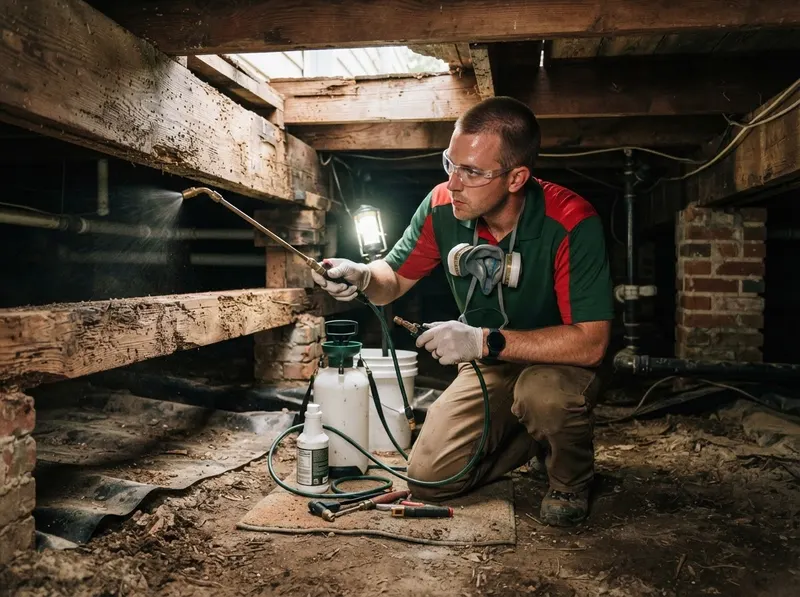
Remediation focuses on terminating active larvae deep within the wood grain rather than applying superficial barrier sprays. WillowCrest Pest Management utilizes targeted applications of disodium octaborate tetrahydrate formulated in accordance with EPA pesticide standards, diffusing directly into unfinished framing members to eliminate active feeding larvae and prevent reinfestation. Historic homes in neighborhoods such as South of Broad, Harleston Village, and Radcliffeborough often feature dense, unsealed heart pine and cypress joists that require precise topical surface wetting, whereas newer builds in Daniel Island and Wagener Terrace often present beetle emergence within crawl space subflooring boards. Technical guidelines from the USDA Forest Products Laboratory indicate that borate solutions penetrate sapwood reliably when wood moisture content is monitored alongside relative ambient humidity.
Controlling subterranean moisture remains an essential step to prevent secondary wood decay from fungi like Serpula lacrymans. Guidelines outlined by the U.S. Department of Housing and Urban Development and the International Code Council recommend maintaining crawl space relative humidity below 60% through continuous ground-cover vapor retarders and adequate foundation ventilation to suppress future wood-boring beetle re-emergence. For properties with extensive subterranean activity near marshes or tidal creeks, technicians evaluate framing in alignment with the South Carolina Department of Environmental Services watershed guidelines, ensuring non-target soil and local water tables remain unaffected.
Structural protection operates in four sequential steps: 1. Technicians assess visible joists using digital pin-type moisture meters calibrated to standards from ASTM International to identify active wood-destroying insect zones. 2. Wood surfaces are cleared of loose frass and surface debris using HEPA-filtered vacuum units to expose clean timber grain. 3. Borate-based termiticide and insecticide solutions are applied in strict adherence to OSHA chemical safety standards and label rates to achieve maximum diffusion depth. 4. A follow-up inspection checks moisture suppression markers and verifies that larval activity has ceased without binding clients to mandatory multi-year billing schedules.
Every job gets a firm, written price after a free on-site visit.
Tell us about your powderpost beetle remediation job in Charleston and we'll send a clear, written quote, usually the same day.
 WillowCrest Pest Management