Coastal humidity, tidal water fluctuations, and sea-level elevations make outdoor living spaces in Charleston County uniquely vulnerable to dense biting insect populations. Salt marsh species like Aedes taeniorhynchus…
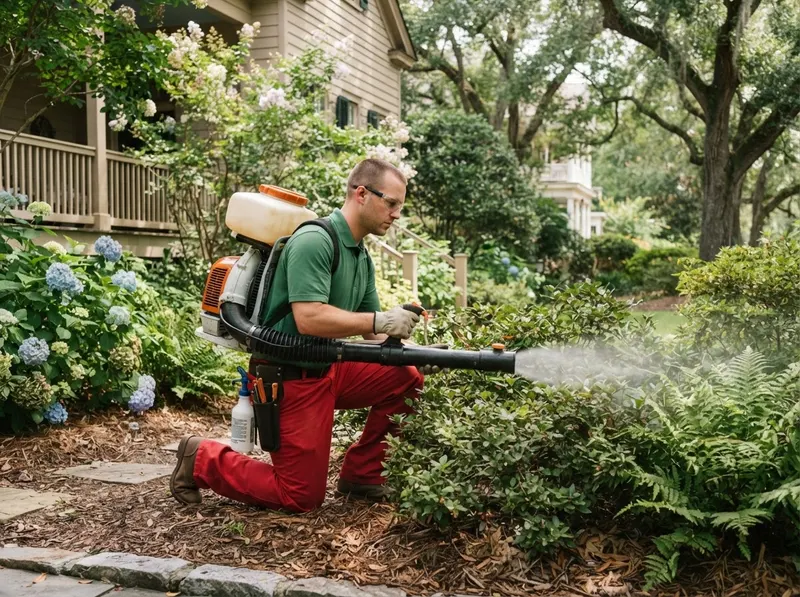
Coastal humidity, tidal water fluctuations, and sea-level elevations make outdoor living spaces in Charleston County uniquely vulnerable to dense biting insect populations. Salt marsh species like Aedes taeniorhynchus and inland container breeders such as Aedes albopictus shelter on the undersides of wax myrtles, palmettos, and broadleaf ornamental shrubs during the heat of the day. A residual barrier treatment deposits an insoluble microencapsulated compound onto these precise resting leaves, targeting adult vectors as they harbor in shaded cover. When treating properties in historic downtown districts like South of Broad, Harleston Village, and Radcliffeborough, tight boundary lines and brick walled courtyards require precision backpack misting that controls drift while thoroughly coating climbing ivy and shaded foundational beds.
In waterfront communities including Daniel Island, James Island, and the Cainhoy Peninsula, mosquito reproduction surges alongside pluvial flooding and high king tide cycles. Larval control forms a critical non-obvious component of lasting barrier defense; adulticidal sprays alone fail if open standing water continually yields new broods every 7 to 10 days. Technicians apply bacterial larvicides such as Bacillus thuringiensis israelensis to non-draining drainage swales, catch basins, and bromeliads to disrupt the juvenile lifecycle before pupation occurs. Water bodies connected directly to public marshlands are strictly protected under guidelines from the South Carolina Department of Health and Environmental Control, preventing unbuffered chemical broadcast into natural tidal estuaries. Homeowners near marsh borders in West Ashley and Wagener Terrace receive calibrated perimeter buffers that suppress yard infestations without impacting vulnerable brackish ecologies.
Automated misting systems provide continuous suppression for larger parcels or properties hosting regular outdoor gatherings near the Ashley or Cooper rivers. These networks use durable nylon tubing fitted with brass or stainless steel atomizing nozzles mounted every 10 to 15 feet along fence perimeters, deck eaves, and shaded tree lines. Calibrated controllers release low-concentration botanical or pyrethroid mists during peak insect flight hours at dawn and dusk, conforming to safety thresholds defined by the United States Environmental Protection Agency. For properties with modest square footage, recurring backpack barrier treatments scheduled every 21 to 28 days match the local biological cycle without the infrastructure cost or nozzle maintenance demanded by permanent tank systems.
Property owners evaluate barrier applications based on direct yard layout and water proximity. 1. A physical survey maps dense foliage, vegetable gardens, and pollinator zones to protect beneficial insects highlighted by the Pollinator Partnership. 2. Granular or briquette larvicides are introduced into unremovable standing water sources according to standards outlined by the American Mosquito Control Association. 3. Technicians apply electrostatic or low-volume mist to perimeter shrubs, bamboo screens, and under-deck structures up to a height of 10 feet. 4. Product residue bonds to vegetative surfaces within 30 to 60 minutes, withstanding daily maritime humidity and rain showers up to 1.5 inches. 5. Follow-up treatments refresh barrier potency across the peak coastal season extending from April through late October. WillowCrest Pest Management provides these standalone services without mandating multi-year contracts, ensuring Charleston residences remain protected through simple, seasonal scheduling reachable at (843) 268-6994.
Every job gets a firm, written price after a free on-site visit.
Tell us about your mosquito misting & barrier treatment job in Charleston and we'll send a clear, written quote, usually the same day.
 WillowCrest Pest Management