Carpenter ant structural control requires pinpointing wood moisture thresholds before executing treatment. Unlike eastern subterranean termites that ingest cellulose, species such as Camponotus pennsylvanicus carve…
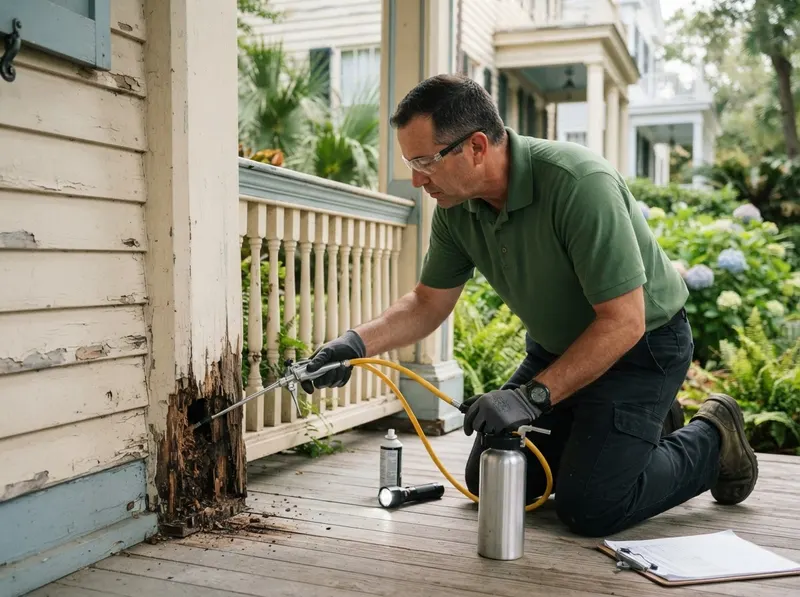
Carpenter ant structural control requires pinpointing wood moisture thresholds before executing treatment. Unlike eastern subterranean termites that ingest cellulose, species such as Camponotus pennsylvanicus carve smooth galleries strictly for nesting, leaving behind coarse, sawdust-like frass containing insect parts. In historic Charleston environments like South of Broad, Harleston Village, and Radcliffeborough, moisture intrusion often softens heart pine sill plates, wall studs, and joist pockets beneath antique plaster. Once timber moisture exceeds roughly 15 to 20 percent, parent colonies outdoors readily launch satellite nests directly inside dead air cavities. Effective mitigation focuses on pinpoint void injections that penetrate wall cavities without disruptive structural demolition, combined with external perimeter defenses that respect nearby coastal marshlands.
Modern residential construction across Daniel Island, the Cainhoy Peninsula, and West Ashley presents a separate vector where roof-line plumbing penetrations, flashing failures, and subfloor dampness attract secondary nesting sites. Standard retail sprays merely trigger chemical repellency, which fractures a single nesting colony into several defensive, decentralized pockets across the building frame. Professional remediation leverages slow-acting, non-repellent products aligned with guidelines from the Clemson University Department of Pesticide Regulation, enabling foraging workers to passively track the active material back into satellite and parental brood chambers. In elevated foundation homes common to James Island and Wagener Terrace, technicians trace structural pathways starting in the crawlspace, assessing subflooring alongside standards outlined by the Charles Towne Landing State Historic Site conservation methods for coastal humidity.
Targeted remediation balances swift wood preservation against unnecessary whole-structure fumigation. Choosing a focused structural void treatment paired with moisture management directly halts excavation activity, preserving framed assemblies without the mandatory multi-year billing commitments enforced by traditional exterminators. For properties bordering fragile coastal wetlands, technicians apply low-impact compounds evaluated under the EPA Office of Pesticide Programs standards, establishing an exterior barrier that limits runoff into tidal creeks. Homeowners may reach our local team by calling (843) 268-6994 or submitting structural timber photos via text to initiate an evaluation, securing lasting preservation for historical and modern coastal framing.
Every job gets a firm, written price after a free on-site visit.
Tell us about your carpenter ant structural control job in Charleston and we'll send a clear, written quote, usually the same day.
 WillowCrest Pest Management